

Neurodivergent system thinking describes how my brain processes patterns, connections, and systems in a way that has shaped my entire career, identity, and work with Ulement.
How did I realise I am a neurodivergent system thinker?
I did not start by reading a textbook definition. I started by noticing that I rarely see “one thing at a time”. When I look at a website, I see hosting, caching, CSS, user intent, search queries, funnels, and business models all lighting up in my head at once. Later, learning about neurodiversity gave me language for something I had quietly lived with for years: my brain is wired differently, and that difference is not a flaw, it is a system.
In my mid-30s, I discovered that I am on the Asperger/autistic spectrum. That moment was like someone finally handing me the legend to a map I had been using my whole life. It suddenly made sense why I always behaved differently and why I often felt out of sync, as if others were not seeing the problems and connections that were crystal clear to me.
How does my brain experience systems thinking?
For me, systems thinking means I almost never see isolated problems. A slow page is not “a slow page”. It is a signal from an entire ecosystem. My mind jumps between:
- Server configuration and network latency
- Theme and plugin architecture
- Elementor structure, DOM size, third-party scripts
- Core Web Vitals, search intent, and user journeys

All of this shows up as patterns rather than separate items. I do not consciously “try” to connect them; my brain connects them automatically. I then have to work backwards to translate that logic for others.
Before and after discovering I am autistic
Before I knew I was autistic, I spent a lot of time feeling frustrated and unhappy with many parts of life. Things rarely worked the way I thought they should work. Systems felt inefficient, decisions seemed irrational, and people often ignored obvious problems that were screaming at me.
Looking back, my behaviour towards co-workers was probably similar to Sheldon Cooper from The Big Bang Theory. I would correct people’s mistakes in meetings without realising it came across as condescending. I insisted on “the right way” to solve the problems, often dismissing alternatives as objectively inferior. I did not understand why colleagues seemed annoyed when I pointed out logical inconsistencies in their reasoning or why they interpreted my directness as rudeness. To me, I was just being accurate and efficient. To them, I was being difficult and socially tone-deaf.
Discovering my Asperger/autistic profile reframed this completely. It did not change my perception, but it changed my interpretation of that perception. I stopped seeing my reactions as anger at others and started seeing them as a clash between my systems-level view and environments that were not designed for that kind of thinking. I also began to understand that what felt like “stating facts” to me often landed as judgement or superiority to others, not because I intended it that way, but because our communication styles were fundamentally different.
How does neurodivergence show up in my work?
I spent 20+ years working in 4A advertising before starting my own business. I originally focused on graphic design, but as clients kept asking for help with their websites, I dove into web development through intense self-learning.
Many ex-colleagues from my agency days were confused by this shift. They viewed creative design and technical development as totally different skill sets and wondered how I could manage both. But where they saw two different worlds, my brain just saw new patterns to decode. Whether it is a visual layout or a server configuration, it is all just a system.

Over time, I began to recognise that the traits driving this career evolution were actually neurodivergent markers:
- Intense special interests in WordPress, performance, and SEO which allowed me to self-teach complex topics rapidly.
- Hyperfocus that makes time disappear when I am debugging code or optimising a funnel.
- Sensitivity to inconsistencies, whether in a visual brand identity or a “messy” database structure.
- Difficulty pretending to care about surface-level metrics if the underlying system is broken.
Learning about my autism did not change how I think, but it did change how I understand myself. It gave me permission to stop masking so heavily and to treat my thinking style, specifically the ability to bridge design and code naturally, as an asset instead of a quirk.
How did this shape my career and Ulement?
My career has never been “only” about building websites. It has always been about designing systems. As I worked with more SMEs and enterprises, I realised I was naturally mapping complete ecosystems:
- How traffic sources interact with content and funnels
- How technical debt accumulates through theme and plugin choices
- How teams, processes, and tools either support or choke performance
For my clients, this means they do not just get a faster website; they get a resilient system designed to survive traffic spikes, content updates, and future growth. This systems lens pushed me beyond being “a developer” into being a consultant and eventually the founder of Ulement. It is also how I became known as an Elementor Performance Expert: I do not treat performance as page-by-page tweaking, I treat it as system architecture. The way my brain connects signals, patterns, and constraints makes performance work feel like solving a giant multi-layer puzzle.
What does pattern recognition feel like in real projects?
On a practical level, my neurodivergent system thinking often shows up like this:
- I notice repeating plugin conflicts across completely different clients.
- I see that certain design choices always lead to layout shifts or CLS issues.
- I recognise that the same type of content structure repeatedly fails to rank, regardless of niche.

Once I see these patterns, I cannot unsee them. I start building frameworks, checklists, and mental models. Over time, that becomes part of my consulting method: clients do not only get a “fix”, they get the benefit of all the patterns my brain has seen before.
How has this influenced my role in the WordPress community?
WordCamp KL was a pivotal moment for me as it was the first event I attended after my Asperger diagnosis. Looking around the room, I realised I was far from alone. I believe there are many individuals in this space who are neurodivergent but yet to be diagnosed, simply because I saw the same traits in them that I see in myself. We are a community often united by a focus on logic, deep attention to detail, and a drive to pursue specific interests.
This perspective shapes how I view the WordPress ecosystem. When I attend events now, I do not just see a schedule of talks. I see a living ecosystem where organisers, speakers, sponsors, agencies, and individual contributors form an interconnected network.
My systems thinking makes me look for the deeper patterns in this network:
- How does this event support local businesses long term?
- How do tools, education, and hosting work together (or against each other) for the end user?
This is one reason I am involved in WordCamps. I am interested in how the community behaves as a system, not just how a single event “went”.one reason I am involved in WordCamps and conversations around accessibility and neurodiversity. I am interested in how the community behaves as a system, not just how a single event “went”.
What are the challenges behind the strengths?
The same traits that help me see systems also bring challenges:
- My brain does not like fragmented, noisy environments. Open offices and constant context-switching drain me quickly.
- Communication misalignments happen when my mind jumps several steps ahead while others are still on step one.
- Masking to fit expectations in meetings or “traditional” work cultures is exhausting.
Before I understood my autism, these challenges felt like vague personal failures. After the discovery, they became design constraints. Instead of forcing myself into environments that break me, I focus on configuring my work and life in ways that respect how my brain works.
How do I look after my well-being as a neurodivergent system thinker?
Over the years I have started designing my life the same way I design systems:
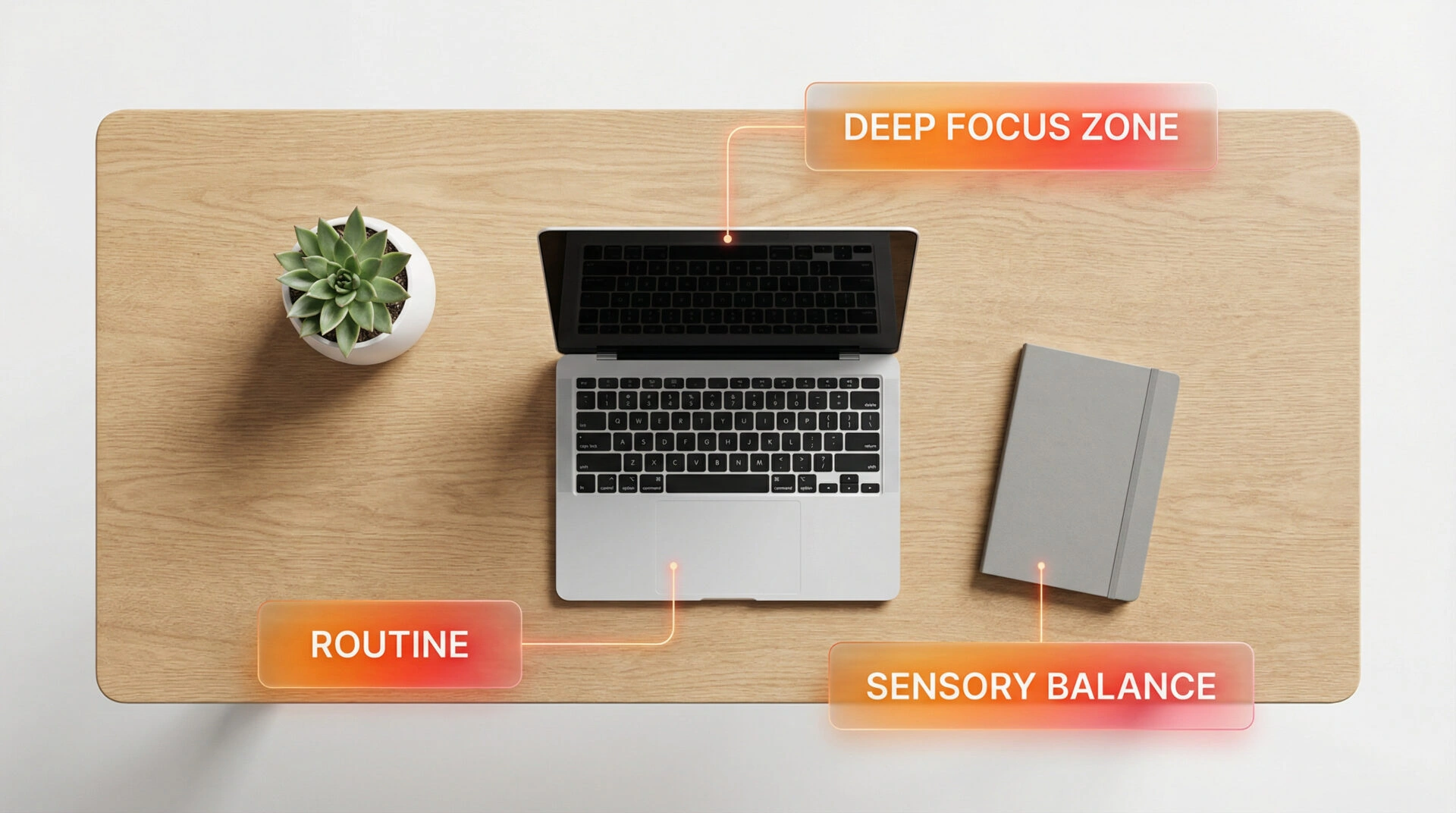
- I build routines around my natural energy patterns, not arbitrary schedules.
- I protect deep-focus blocks for analysis, strategy, and performance work.
- I am more honest with clients and collaborators about how I work best.

Treating my brain as a system to understand rather than a problem to “fix” has been a big shift. It allows me to honour my hyperfocus, protect my sensory needs, and use my pattern recognition intentionally.
So, what is a neurodivergent system thinker, to me?
For me, a neurodivergent system thinker is someone whose differently wired brain naturally sees connections, feedback loops, and patterns across everything: technology, business, communities, and inner life. It is not a clinical label, it is a lived pattern.
It is the reason I build WordPress architectures the way I do, why I obsess about performance, why I care so much about ethics and fairness in tech, and why I used to feel constantly frustrated with how things “should” work. Today, instead of fighting that part of me, I build my work, my company, and my contributions around it.
If you recognise yourself in this story
Many people go through their entire lives feeling out of sync, not because they think something is wrong with them, but because they cannot understand why everyone else seems to be missing what is obvious. They mask, they push through, they burn out, wondering why the world operates so inefficiently whilst others seem comfortable with it.
If this article resonates with you, if you have always felt like you see systems others miss, if you have struggled with environments that demand you think differently, you are not alone. Understanding that you might be neurodivergent does not solve everything overnight, but it can change how you interpret your experiences, how you design your work, and how you advocate for yourself.
I hope sharing my journey helps you recognise your own patterns, honour your wiring, and build a life and career that works with how your brain operates, not against it.